




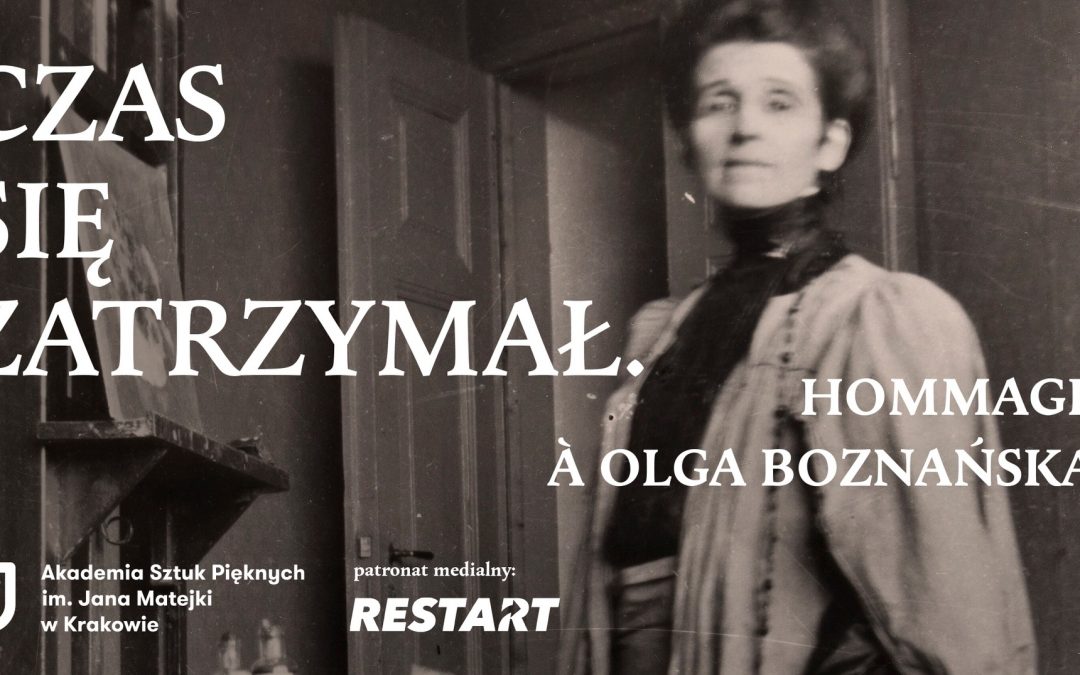
We invite you to the exhibition “Time Has Stopped: Hommage à Olga Boznańska,” which will open on Thursday, January 15, at 2:00 p.m. at the Academy of Fine Arts Gallery in Kraków (18 Basztowa St.). The exhibition will be on view through February 15.
Artists: Anna Andrzejewska / Olga Boznańska / Iwona Demko / Sylwia Górak / Dorota Herbik / Marek Herbik / Bartek Jarmoliński / Roksana Kularska-Król / Julia Kurek / Robert Kuśmirowski / Paweł Łyjak / Krzysztof Nowicki / Maria Piątek / Paulina Poczęta / Sławomir Toman
curator: Bartek Jarmoliński
When the concept for an exhibition exploring contemporary references to Olga Boznańska first emerged—in 2024— the key question turned out to be what role this artist’s paintings play today, whether they can be interpreted differently now than when they were created, and, above all, for which artists Boznańska is an important enough figure to inspire an artistic dialogue between their works and three sections of Boznańska’s works from private collections. This was followed by the question of what framework should be used to structure this exhibition.
The title “Time Has Stopped” has a dual meaning. It refers to Olga Boznańska herself—as a person, a personality, a distinctive figure bustling about her spacious and cluttered studio, which, like its owner, seemed to exist independently of the times in which she lived, with the artist’s radiant inner strength, her intuition about people, and her sensitivity to the world—qualities that allowed her to do what she loved most: paint. The second meaning of the title refers to the moment when we pause, even for just a moment, to take a closer look at Olga Boznańska’s paintings. When analyzing her rich body of work, one can speak of the phenomenon of her painting and the talent that Boznańska possessed. Already referred to by her contemporaries as the “painter of gray,” she was in reality a master of color and form; like few others in the art of that period, she was able to capture the truth about the people she portrayed. The eyes and hands of her subjects became key elements. Olga Boznańska’s paintings reveal to us the power of painting, the artist’s inner strength, her ambitions, and her sensitivity—all of which are evident in everything she created throughout her life.
The exhibition of contemporary references to Olga Boznańska consists of several significant aspects. The first is the reference to—and, consequently, the inspiration drawn from—the artist’s image and her portraits, which possess a psychological depth in the subjects they depict. This aspect seems quite obvious, as portraiture was a key area of Olga Boznańska’s painterly approach. This area includes paintings by Sławomir Toman, Dorota Herbik, and Bartłomiej Jarmoliński; photographs by Anna Andrzejewska; a collage by Maria Piątek; and a sculpture by Julia Kurek.
Another aspect of these references is the painting of Velázquez. Why? Boznańska adored the paintings—and portraits in particular—of the greatest master of 17th-century Spanish painting. Ever since her youth, when she saw Velázquez’s works in person in Vienna, Munich, and Berlin, her fascination with the brilliant colors and bold brushwork of the genius Spaniard has never waned. This section features paintings by Krzysztof Nowicki, who draws on motifs from 17th-century works—including those by Velázquez—giving them a character distinct from the originals, in which the passage of time and the subtleties arising from the artist’s rich painterly texture raise the question of what a portrait truly is.
The exhibition could not fail to include references to Olga Boznańska as a female artist who embodies talent, ambition, diligence, and career—for that word best describes everything she managed to achieve. It serves as a reminder of women’s emancipation; it was not until the first half of the 20th century that women were granted the rights previously reserved for men. This section features photographs by Iwona Demko and Roksana Kularska-Król.
There is also the aspect of stories connected with Boznańska—her little-known tales of friendship and places in Paris. It is precisely these stories that Marek Herbik and Paweł Łyjak refer to. The exhibition also features an audio element, as Robert Kuśmirowski created a phonogram based on Boznańska’s “Portrait of Józef Czajkowski.” This work consists of a sound card (phonographic) along with a recording of the soundtrack that the artist generated based on the patterns of color patches and color combinations found in Boznańska’s painting.
When analyzing Olga Boznańska’s portraits, one can see that the artist focused primarily on the eyes of her subjects, because that is where the truth was revealed. The softness evident in her portraits—as well as in all her paintings—was linked to Boznańska’s vision impairment. Sylwia Górak addressed the issue of visual impairment and its impact on painting in her own portraits. The objects sewn by Paulina Poczęta featured motifs of lips, which complemented the character of the portraits—which, within this concept, were depictions of figures and objects that Boznańska might have had in her Paris studio.
In the article “Pankiewicz and Boznańska,” which appeared in *Głos Plastyków* in 1946, Jerzy Wolff compares Olga Boznańska’s work to that of Pankiewicz (whom the artist detested) as follows:
Her art possesses the same gentle intimacy that characterizes both Vuillard’s portraits and those of the early Bonnard; one can see reflected in their paintings the mood of comfortable security in Europe at that time, as well as the atmosphere of a bourgeois interior of the era—full of upholstered sofas and armchairs, covered with a plush rug, and hung with portraits framed in dark velvet. Pankiewicz, on the other hand, despite his great cultural refinement, appears in his paintings almost as a talented student of those Western artists; despite a delicacy bordering on politeness, he comes across as a man who has merely “assimilated” their style. His art serves as a bridge connecting us to European art, while Boznańska’s art represents our contribution to that tradition.
The exhibition “Time Has Stopped: Hommage à Olga Boznańska” is a tribute to Olga Boznańska by contemporary Polish artists.
Bartek Jarmoliński