




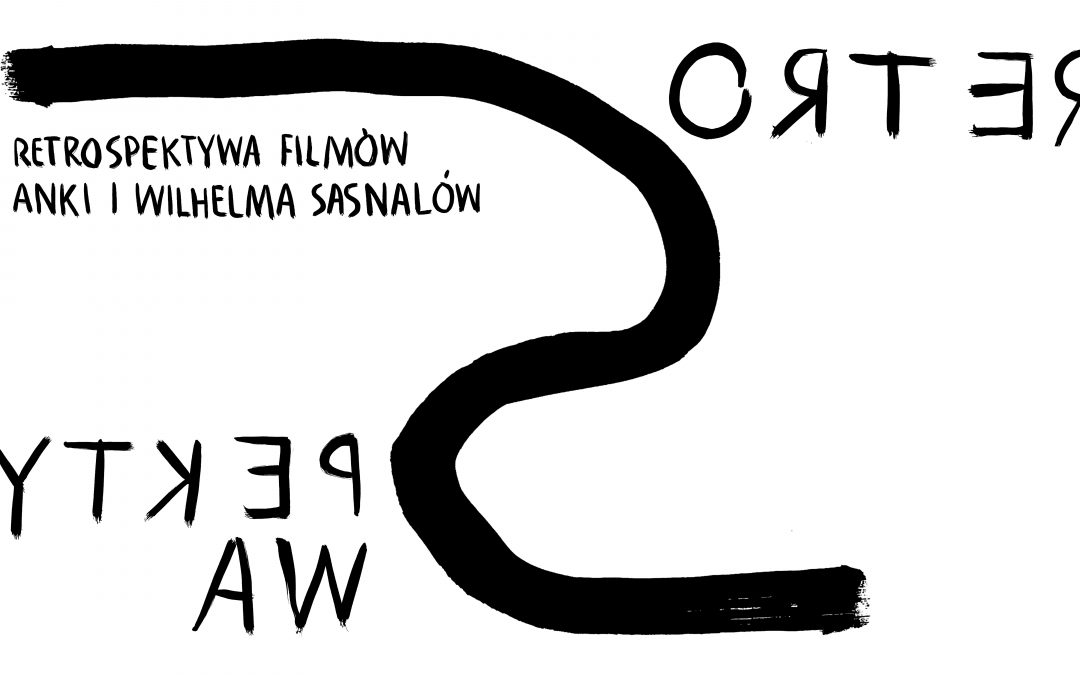
Five evenings, five short films, and five feature-length films—join us for a unique screening of films by Anka and Wilhelm Sasnala. The “Retrospective” will take place January 17–21 at the ASP Cinema at 13 Matejko Square in Kraków. A Q&A session with the artists will follow each screening. The screening will be an opportunity to revisit the artists’ body of work ahead of the premiere of their latest film, “Człowiek od wszystkiego,” which will take place on January 25 at the Pod Baranami Cinema in the Academy of Fine Arts auditorium.
This is cinema created by a pair of artists for whom the medium of film has become a language of artistic expression.
It is a vision, a voice in the discussion, and a penetrating observation of reality on the artist’s own terms.
RETROSPECTIVE
January 17–21, 8:00 p.m.
ASP Cinema – Auditorium
13 Matejko Square, Kraków
Free admission
PROGRAM
Saturday, January 17, 8:00 p.m. *The Moon's Daughter* + *The View Is Beautiful From Afar*
"The View Is Beautiful from Afar," 2011, 77 min
Written and directed by: Anka Sasnal, Wilhelm Sasnal
Produced by: Anton Kern Gallery, Anka Sasnal, and Wilhelm Sasnal
Starring: Marcin Czarnik, Agnieszka Podsiadlik, Piotr Nowak, Elżbieta Okupska, Jerzy Łapiński, Hanka Chojnacka, Michał Pietrzak, Beata Zygarlicka, Waldemar Czyszak, Joanna Drozda, Oskar Karaś, Dawid Wolski
Cinematography: Wilhelm Sasnal, Aleksander Trafas
Set Design: Marek Zawierucha
Costumes: Ewelina Gąsior
Makeup: Zuza Stefańska
Sound: Igor Kłaczyński
Editing: Beata Walentowska
Production Management: Agata Szymańska, Tomasz Kozera
Executive Producer: Filmpolis Agata Szymańska
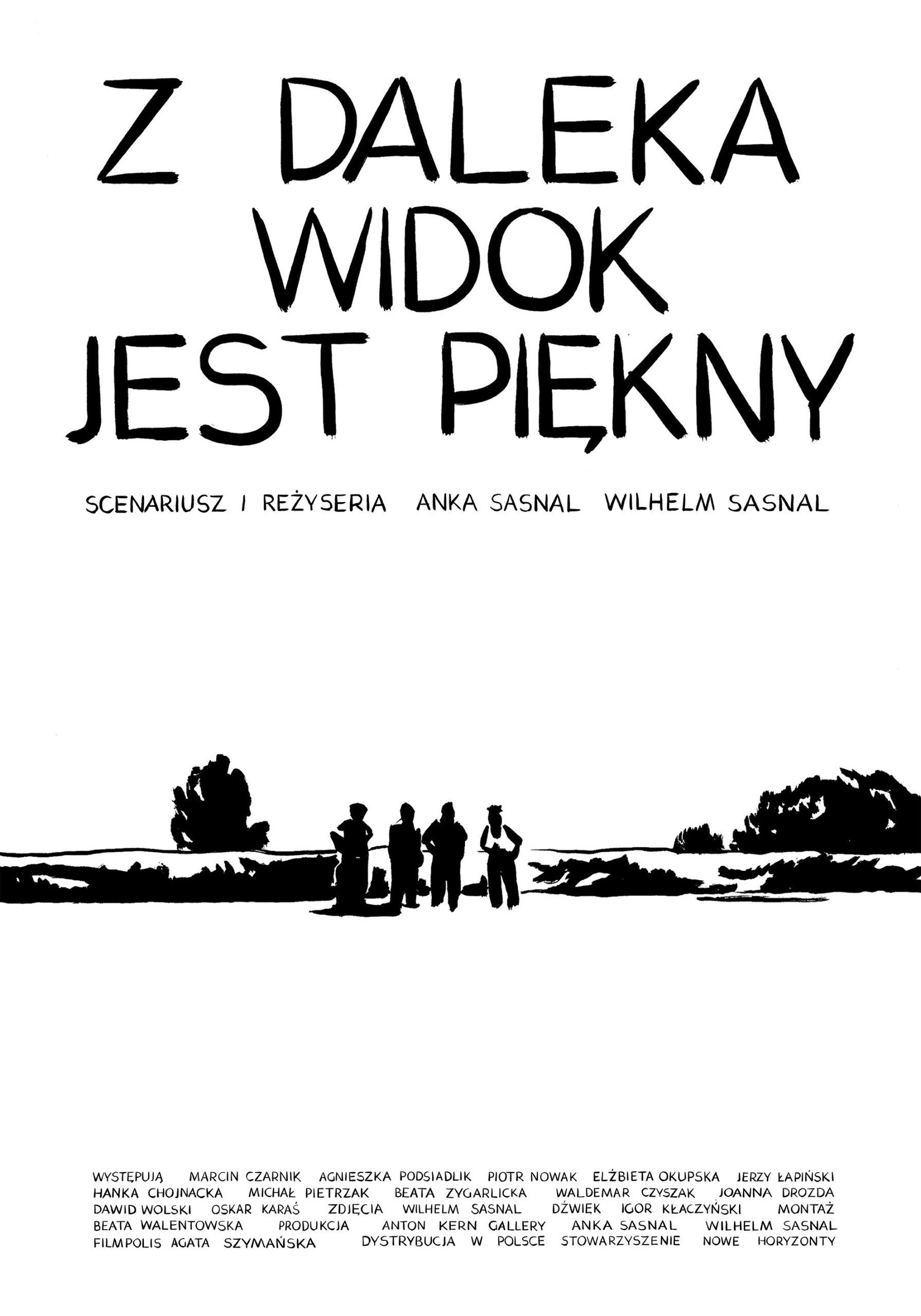
A village on the road from Kraków to Tarnów, a sweltering summer. Everything is falling apart; people make a living mainly by scavenging all kinds of trash—scrap, waste, and discarded items lie scattered across yards enclosed by rickety fences. The main character, Paweł, makes a living collecting scrap metal. He lives at home with his elderly, ailing, and mentally unstable mother; unable to cope with her, he sends her to a nursing home. He has a fiancée, and they plan to get married. But one day Paweł suddenly disappears; no one knows where he is. The neighbors begin stealing various items from the abandoned house. The first to start this practice is the man’s future father-in-law. At first, Paweł’s neighbors steal things from his house secretly, sheepishly, under the cover of night; later, they do so completely openly. At one point, the entire village gathers around the house, takes everything that might be useful (even the windows are torn from their frames), and demolishes it completely. Paweł returns to his home village. There’s nothing left for him there. And since the hardest things to forgive are the wrongs we’ve done to others, the community won’t let him stay.
Jakub Majmurek
Sunday, January 18, 8:00 p.m. "The City of a Million" + HUBA
"Huba," 2013, 66 min
Written and directed by: Anka Sasnal, Wilhelm Sasnal
Produced by: Anka Sasnal, Wilhelm Sasnal, Sadie Coles HQ
Starring: Joanna Drozda, Jerzy Gajlikowski, Wojtek Słowik
Cinematography: Wilhelm Sasnal
Sound: Igor Kłaczyński
Editing: Beata Walentowska
Set Design: Marek Zawierucha
Costumes: Ewelina Gąsior
Makeup: Aleksandra Dutkiewicz
Executive Producer: Filmpolis Agata Szymańska
Production Management: Agata Szymańska, Paweł Przywara
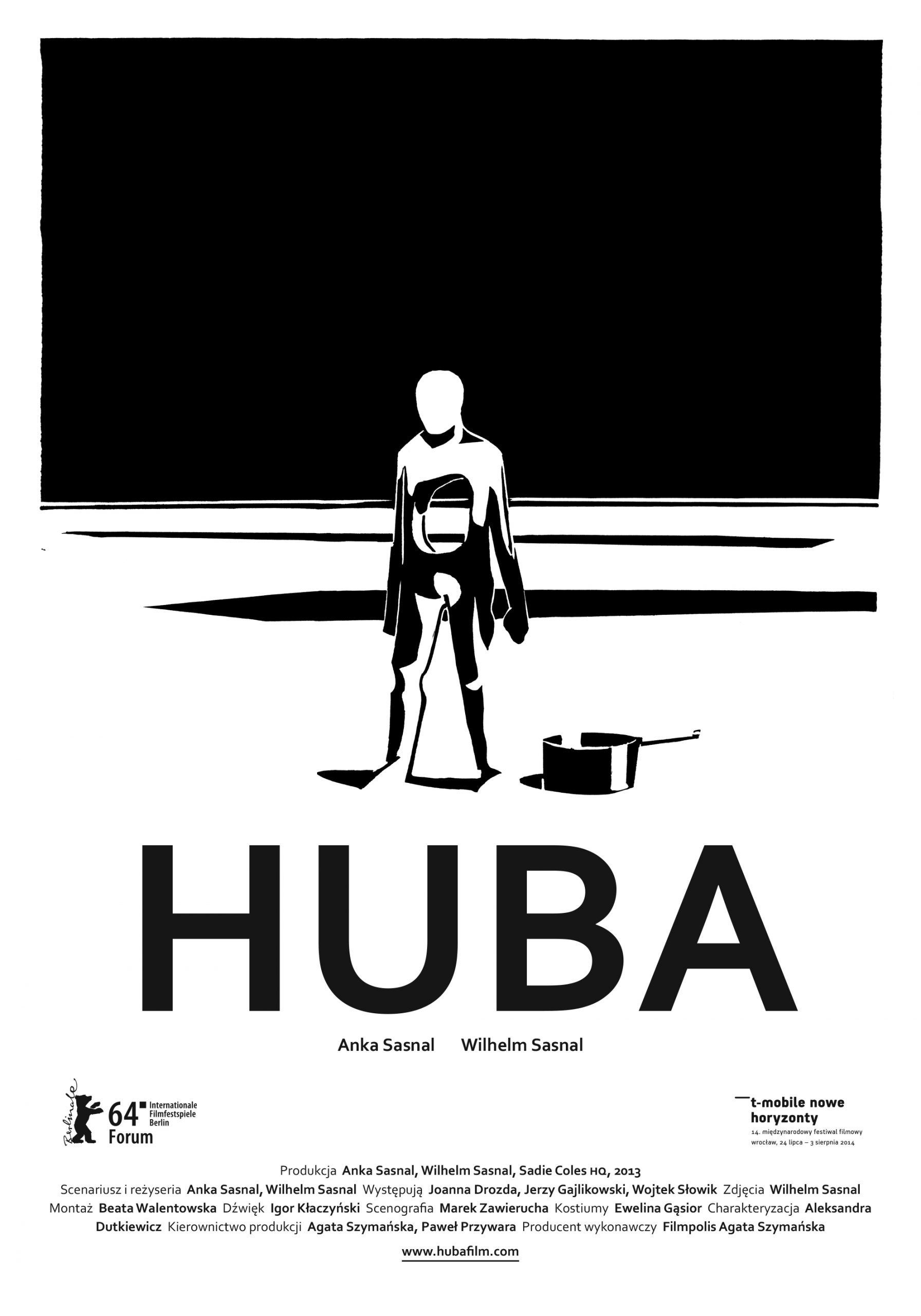
The protagonists of Huba’s film are an old, sick man and a young woman with a child. As he leaves the factory, torn from the rhythm of work, he loses control of time. He cannot sleep or eat. He’s wasting away. She and the child are like a single, fused organism. But this closeness is based on dependence and inequality. The child, most firmly clinging to life, is voracious and draining; the woman, freed for a moment, is nonetheless doomed to violence; and the Old Man, cut off from the factory, has nowhere left to draw strength from. When they attempt to be together, they are like a holy family in reverse. Their haphazard, shared life is one of interpenetration, merging into a single form of oppression. The film observes not only the characters’ monotonous daily lives but also the process of their gradual degradation. This documentary record of reality is complemented by abstract shots, disrupting the linearity of the narrative and transforming it into metaphor.
Monday, January 19, 8:00 p.m. Mojave + THE SUN, THE SUN BLINDED ME
“The Sun—It Was the Sun That Blinded Me,” 2016, 64 min
Written and directed by: Anka Sasnal, Wilhelm Sasnal
Production: Anka Sasnal, Wilhelm Sasnal, Hauser & Wirth, Foksal Gallery Foundation Executive Producer: Luna Film – Ewa Przywara, Paweł Przywara
Production Managers: Ewa Przywara, Paweł Przywara
Cast: Rafał Maćkowiak, Edet Bassey, Małgorzata Zawadzka
Cinematography: Wilhelm Sasnal
Sound: Igor Kłaczyński
Editing: Beata Walentowska
Set Design: Marek Zawierucha
Costumes: Ewelina Gąsior
Makeup: Aleksandra Dutkiewicz
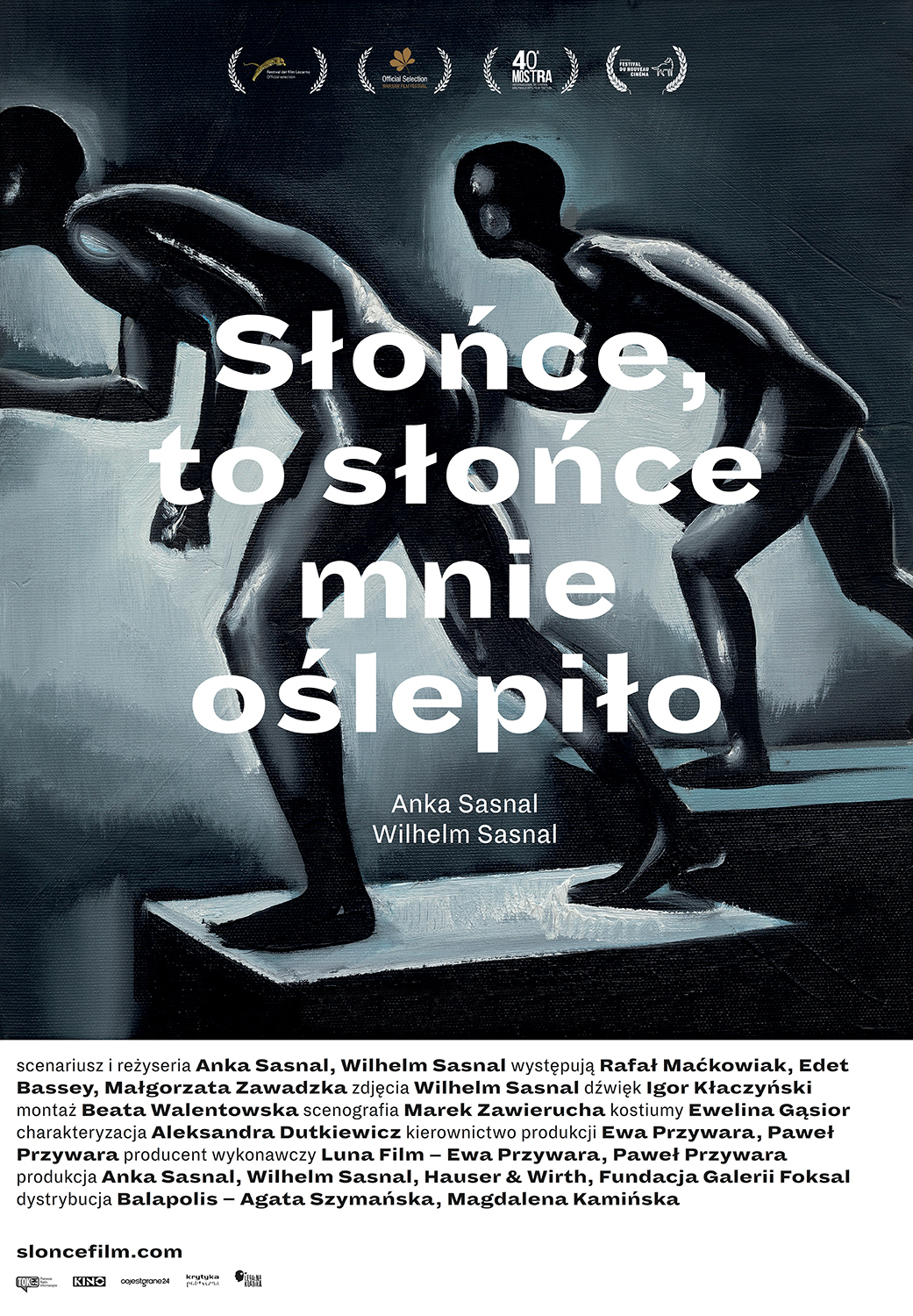
The main character, Rafał Mularz, is an outsider by choice.
He does not follow generally accepted rules. His alienation is a matter of life choice, an escape from fears, desires, dreams, and ambitions. One day, he meets a man with a different skin color, even more of an outsider than he is—an Outsider by definition. The film paints a portrait not only of the main character but also of contemporary society, which usually points a finger at anything that is different or distinct. What does an encounter with a Stranger really mean? This question is worth asking both on an individual level and in a broader, societal context, especially in times of rising nationalism and xenophobia in countries such as Poland.
He is the accused. But we are the guilty ones.
Tuesday, January 20, 8:00 p.m. Love Songs + WE HAVEN'T LOST OUR WAY
"We Haven't Lost Our Way," 2022, 74 min
Screenplay: Anka Sasnal
Directed by: Anka Sasnal, Wilhelm Sasnal
Production: Balapolis – Agata Szymańska, Magdalena Kamińska
Co-production: Anton Kern Gallery, New York, Anka Sasnal, Wilhelm Sasnal, Krakow Festival Office
A film co-financed by the Polish Film Institute
Executive Producer: Luna Film – Paweł Przywara
Production Managers: Ewa Przywara, Paweł Przywara
Starring: Andrzej Konopka, Agnieszka Żulewska, Oskar Hamerski, Małgorzata Zawadzka, Roman Gancarczyk, Rita Sasnal
Cinematography: Wilhelm Sasnal
Sound: Igor Kłaczyski
Music: Jakub Ziołek
Editing: Anka Sasnal, Paweł Gardynik
Set Design: Agata Biskup
Costumes: Ewelina Gąsior
Makeup: Aleksandra Dutkiewicz, Julka Kapek
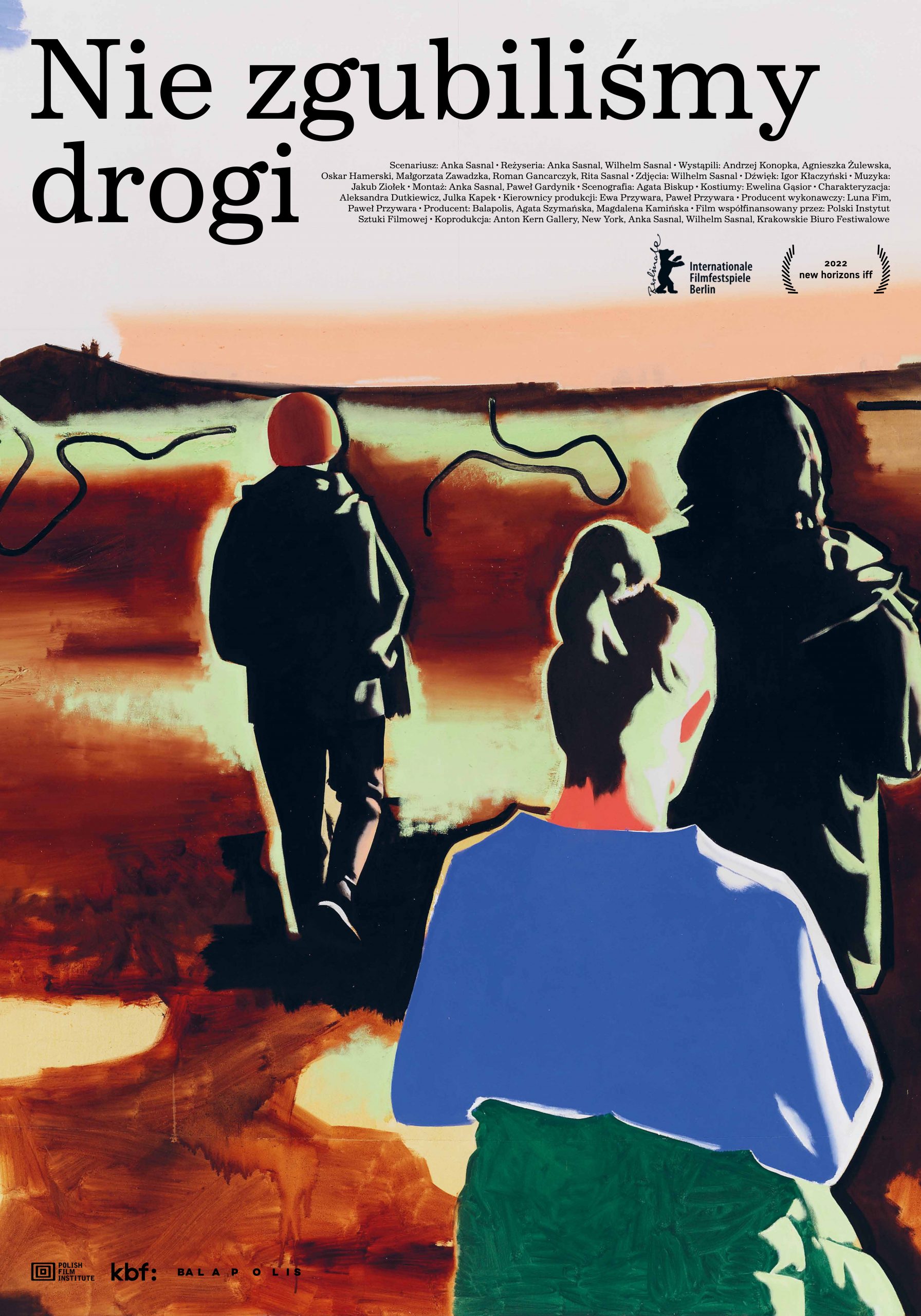
Ewa, one of the film's main characters, is a translator; to make ends meet, she gives private English lessons. It's neither an easy nor a lucrative job. She lives alone but remains close to her family.
Eryk is fired from his job at the university. He reads his own thoughts aloud in class and, according to the students, provokes them with his silence. He therefore fails to meet the expectations of either his students or his employers.
After losing his job as a university lecturer, he decides to leave his old life behind and set out on a journey. The protagonists of the film *We Haven’t Lost Our Way* refuse to participate in a world where stability—based on work, earning money, and meeting social and family expectations—is the most important thing.
Perceived by others as lost, introverted failures in life, they make unexpected, irrational decisions that nevertheless allow them to free themselves, if only for a moment, from the pressures and demands of the modern world.
Wednesday, January 21, 8:00 p.m. The Second Church + ŚWINIOPAS
"The Pig Herder," 2009, 85 min
Screenplay: Wilhelm Sasnal, Anka Sasnal, Marta Bębenek
Directed by: Wilhelm Sasnal
Production: Hauser&Wirth, Wilhelm Sasnal
Starring: Przemek Czepurko, Karolina Kominek, Zbigniew Kosowski, Bartek Materka, Marta Ojrzyńska, Feliks Szajnert, Krzysztof Zarzecki
Cinematography: Wilhelm Sasnal, Aleksander Trafas
Editing: Wilhelm Sasnal
Sound: Igor Kłaczyński, Rafał Nowicki
Costumes and Set Design: Anna Wisz
Production managers: Małgorzata Mleczko, Paweł Gardynik
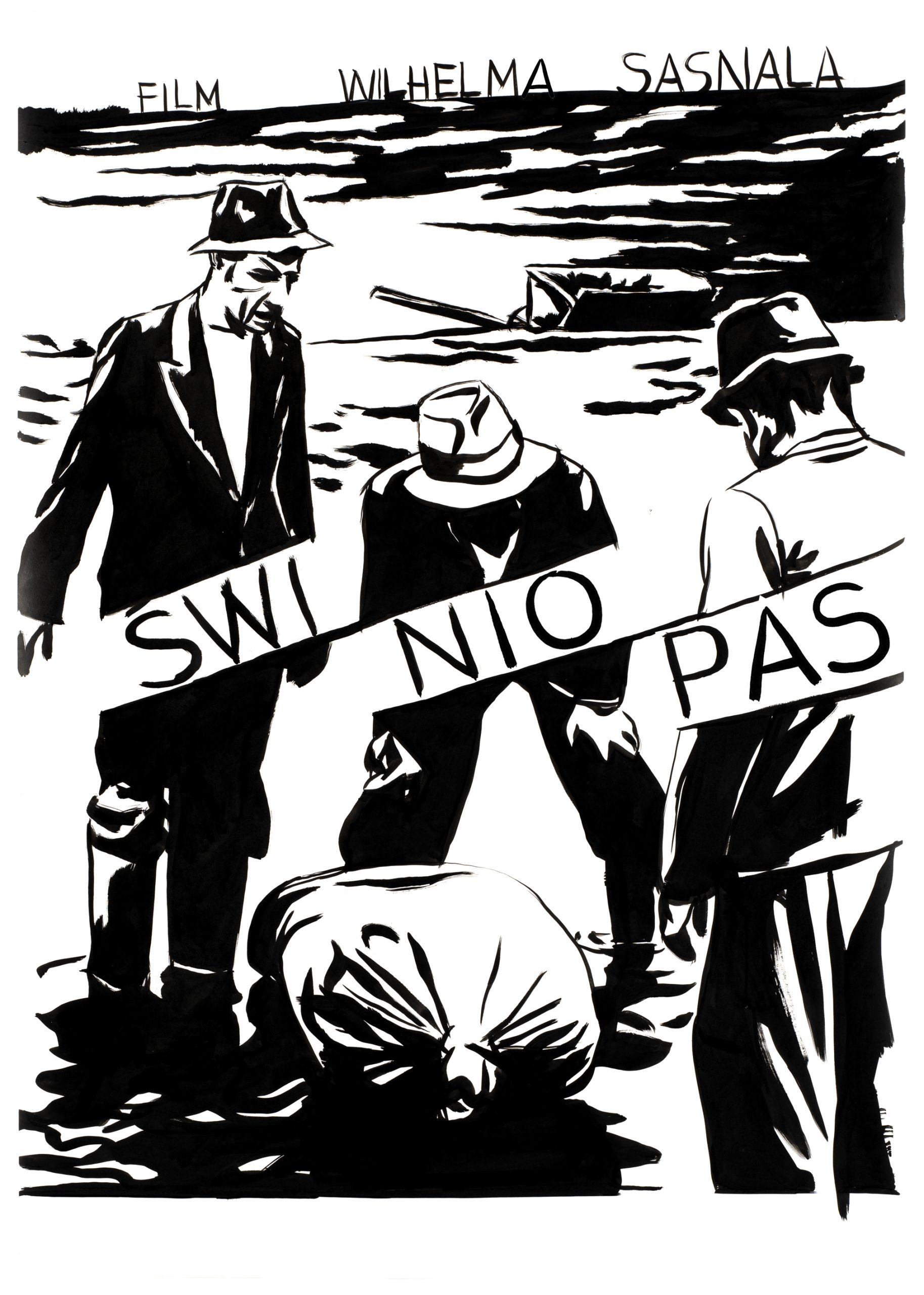
Wilhelm Sasnal’s first feature-length film depicts two days in the life of an unspecified—presumably Polish—village. It is unclear when the film is set, though minor details suggest it takes place after World War II. The main characters are the eponymous Pig Herder, who works for a brutal and primitive farmer; Kaśka, the farmer’s daughter, who is kept under lock and key and treated like a servant; Julka, a girl from the village; and a mysterious drifter with a guitar whose presence irritates the local population. All the villagers are united by their fear and hatred of outsiders, as well as the contempt they harbor for one another. This likely stems from an insatiable desire to escape—a desire that no one acts upon and that no one allows others to act upon. The world in Sasnal’s film is a “cesspool” in which fragments of a degenerate rural reality churn together. The cottages resemble prisons, the barns are hideouts for looted goods, strangers are locked up in the cowsheds, and gold is stored in the graves instead of bodies. The air is heavy and sticky; flies are everywhere. Somewhere in the distance, thick smoke rises, and the barking of dogs can be heard.
This mesmerizing tale of an amorphous reality mirrors the film’s structure, whose individual segments can be viewed as standalone images, similar to those Sasnal had previously created on celluloid and canvas. In *Świniopas*, one can find shots and scenes depicting typical Central European landscapes reminiscent of the *Mościce* painting series, and the characters are portrayed much like in the portraits painted and filmed by the artist: some sketched quickly, in a comic-book style, others with great reverence. Equally intriguing is Sasnal’s cinematic language, which plays with filmic devices—at times adopting the form of a music video (the soundtrack, an element constitutive of both form and narrative, is of paramount importance in all his works), and at other times that of a slideshow—employing unconventional, non-obvious shots, at times creating a sort of film-within-a-film. The most important feature of *Świniopas* is its cinematic and musical metanarrative. Throughout all this, the director strives to remain opaque: he reveals his presence in the film, participates in the action by showing the very process of filming—metaphorically, but also physically—by displaying his shadow and reflection in a windowpane. He introduces a camera into the film—also treated as a metaphor for the creator; he makes it not so much a prop as a protagonist of the action, and ultimately it is destroyed.
Dominik Kuryłek
Ewa Małgorzata Tatar